About
Working across disciplines, I conduct research-based projects that take assorted forms, including installations, drawings, and photography-based series. These projects explore subjects like the nature-culture dichotomy, motherhood as a creative practice, and “the practice of everyday life.” The materials I use tend to be ephemeral, reflecting the subject matter. My academic work has been concerned with women’s life-writing, literary theory and postcolonial literature.Caroline E. Kelley has a D.Phil. and M.St. in women’s writing and gender studies, life-writing, from the Faculty of Medieval and Modern Languages, University of Oxford, and has studied art at the New York Academy of Art (MFA program), Art Students League of New York, and the School of Visual Arts. Her work has been presented and exhibited at galleries and museums in North America, Europe and China and participated in international residencies at The Arctic Circle, Banff Centre for the Arts, Stiftelsen Kulturhuset USF, Artist Residency in Motherhood and the Santa Fe Art Institute for which she was awarded a Joan Mitchell Foundation grant. Her monograph, Women Writing War: The Life-writing of the Algerian moudjahidate, published with Peter Lang Oxford, is part of the series, Studies in Contemporary Women's Writing, edited by Gill Rye, Professor Emeritus at the IMLR, School of Advanced Study, University of London, UK. From 2013 to 2014, she was a Fellow in Multi-Disciplinary Research at the Adrian Piper Research Archive Foundation (APRAF) in Berlin, DE.
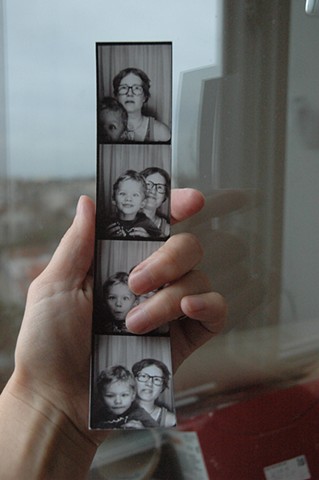
Originally from southeastern Massachusetts (b. 1973), she lives with her partner and son in Lyon, France.
For a complete CV, please contact me. You can also find me here on social media.